

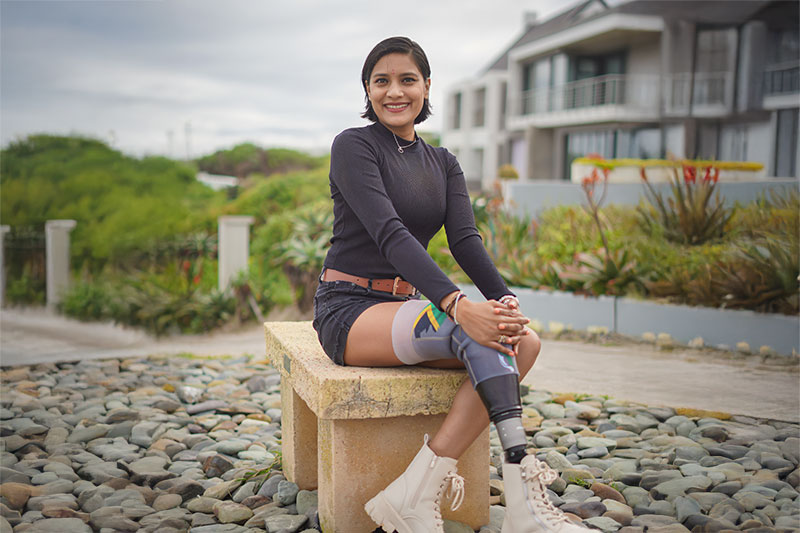
This Women’s Day, PET celebrates women who rise, rebuild, and lead with power — those who define strength and the unshakable pursuit of their purpose, regardless of circumstance. One voice leading this charge is Shay – the powerhouse behind The Shay Way. Redefining ability one step at a time, she’s a disability advocate, model, creator, and speaker whose work is reshaping the way the world sees mobility, identity, and style.
Shay shared her journey with us and why comfort and confidence in prosthetic design are not just preferences, but essentials.
Can you tell us a bit about your journey as an amputee and how it has shaped who you are today?
Losing my leg in a motorcycle accident forced a full system reboot – mentally, emotionally and physically. It’s not just about learning to walk again; it’s about reprogramming how I see myself and the life I planned ahead of me. This journey cracked me open, but it also built the version of me who walks into every room now with power, purpose, and prosthetic confidence. It shaped The Shay Way – not just as a brand, but as a way of showing up fully, scars and all.
How have you used fashion as a form of self-expression and empowerment?
Before my amputation, fashion wasn’t something I paid too much attention to. But after losing my leg, that landscape shifted. Suddenly, what I wore became part of how I rebuilt and reclaimed myself. When I can’t control my body, I control my wardrobe. Some days, I dress up to hide – to blend in, to feel safe. Other days, I show up bold and loud because I want the world to see me exactly as I am. Both are valid. Both are powerful. For me, fashion is no longer just about looking good – it’s about feeling seen, on my own terms. Every outfit is either armour or art. Sometimes both.
You’ve created your own adaptive clothing line – what inspired that journey?
It started with a simple question: “Why doesn’t anyone make this easier for us?” After my amputation, I stood in front of a cupboard full of clothes I loved – and thought I could never wear again. Suddenly, everything had a catch: too tight over the socket, impossible zips, fabrics that irritated the skin. I realised how limiting fashion can feel when your body changes. While there are brands doing amazing work in the adaptive space, I knew I needed to find my way of making style feel effortless and authentic again – on my terms; and for me, it’s always comfort at the forefront!
What are some of the biggest challenges you anticipate in making fashion more inclusive?
One of the biggest challenges is still being taken seriously. Inclusive fashion is often seen as a side project – something nice to have, not a priority. There still seems to be this outdated notion that inclusive design is niche, or clinical and not for fashion runways. That mindset needs to shift. We’re not asking for special treatment – we’re asking to be considered from the start, not retrofitted in at the end. True inclusion means being part of the design conversation from day one.
As someone who is very active and style-conscious, what do you look for in prosthetic products?
I need products that can keep up with me – physically and stylistically. Comfort is non-negotiable, especially on the days when I’m on my feet for hours. But beyond that, I care about the look, too! I want my leg to feel like part of my outfit, not something I have to work around. It has to integrate into my lifestyle without making me choose between function and fashion. Subtle details, smart design, and materials that feel good against the skin – that’s what makes the difference.
What were your first impressions of PET’s products?
The comfort blew me away. I wear my prosthesis for as many hours in the day as possible, so the liner isn’t just a technical detail – it’s everything. With PET’s liners, I can go through a full day and remove it without the usual pain, tenderness, or skin irritation. That’s a HUGE deal. It honestly feels like walking on a cloud – soft, breathable, supportive. You can tell these were designed with real intent – to support how we actually navigate the demands of daily life.
You share such a positive outlook on life as an amputee. What message do you hope to send to your followers?
That you can own your story without shrinking it. That it’s possible to hold both grief and growth at the same time. My journey hasn’t been linear – it’s been messy, real, and full of relearning. But I’ve learned that healing and thriving aren’t opposites – they can co-exist. My platform isn’t about pretending it’s easy. It’s about showing the full spectrum – the setbacks, the small wins, the rebuild. Even in the hardest chapters, there’s still space for beauty, boldness, and becoming. And if I can do it, so can you – on your terms.
Women’s Day in SA celebrates strength and resilience. What message would you like to share with women – particularly those living with disabilities?
You are not broken. You are not a burden. You are not too much or too little. You are enough, exactly as you are – with or without limbs, scars, silence, or noise. This Women’s Day, we don’t just celebrate resilience. We demand visibility. We show up – not in spite of our difference, but because of it.
What are your hopes for the future – for your brand, your community, and for amputees across Africa?
I want The Shay Way to be more than just a brand – I want it to shift the narrative around disability, visibility, and strength. I hope to see more amputees taking up space in fashion, media, and leadership – not as exceptions, but as part of the norm. I want to help build a community that feels seen, supported, and empowered to live fully on their own terms. From daily functionality to bold self-expression, we deserve it all. And we’re just getting started.
Follow Shay’s journey.
Connect with The Shay Way across platforms and witness how she continues to redefine what’s possible – one bold step at a time.
Website: theshayway.com