

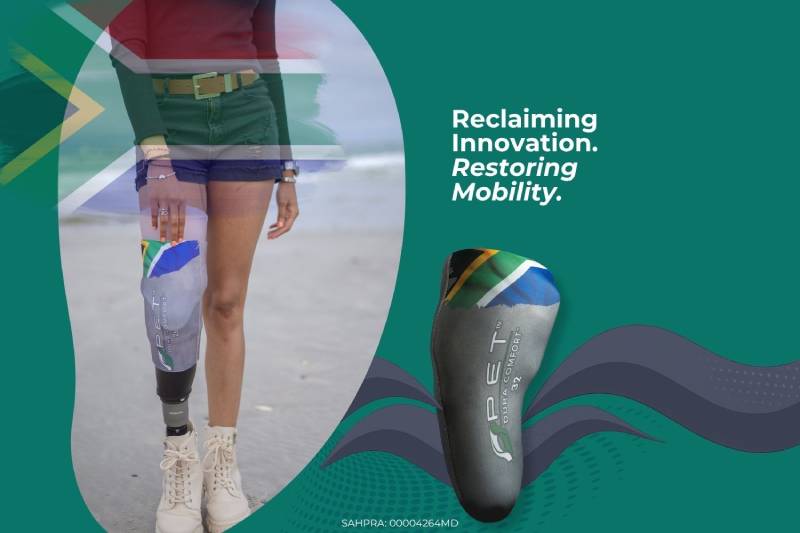
For many South Africans living with limb loss, regaining mobility is not just about technology, it’s about access, comfort, and affordability. For decades, the country’s prosthetics industry has depended almost entirely on imported components. This has created serious challenges for amputees across the board, from high costs and long waiting times to using products that aren’t designed for South African conditions, especially in rural and underserved communities.
According to a 2022 report by the South African Medical Research Council (SAMRC), more than 90% of all medical devices (of which prosthetics are part of) used in South Africa are imported, mainly from the United States, Germany, and China – with only around 10% being exported. Less than 5% of companies are involved in local manufacturing. This heavy reliance on imports adds to the growing trade deficit and holds back local innovation and job creation.
However, with the emergence of Prosthetic Engineering Technologies (PET) and other forward-thinking local companies, South Africa is now in a position to start reversing this trend. PET is a strong example of how local manufacturing can reduce reliance on imports, grow exports, and support both economic development and improved healthcare outcomes.
Turning a Challenge into an Opportunity
Recognising the problem, the South African government saw an opportunity to build local skills, create jobs, and develop homegrown medical technology. Through the Department of Science, Innovation and Technology (DSIT), the Medical Research Council (SAMRC), the Medical Device and Diagnostic Innovation Cluster (MeDDIC), the Council for Scientific and Industrial Research (CSIR), and the Technology Innovation Agency (TIA), support systems were put in place to help innovators bring new medical devices to life.
PET was founded through the drive of individuals who understood, firsthand, the need for a better, more accessible prosthetic solution in South Africa. As PET was taking shape, national programmes like MeDDIC were being developed by the SAMRC to strengthen the local medical device sector. This growing ecosystem, built on collaboration between government, research institutions, and innovation hubs, provided the right support at the right time, helping PET refine its product, access resources, and scale its impact. It’s a powerful example of how local innovation, when met with the right support, can lead to meaningful change.
Built Through Partnership
PET’s journey was made possible with the backing of government agencies, research institutions, and incubators committed to innovation and social impact. Support came from:
- Department of Science, Innovation and Technology (DSIT)
- Medical Research Council (SAMRC)
- MeDDIC
- Council for Scientific and Industrial Research (CSIR)
- Technology Innovation Agency (TIA)
- Industrial Development Corporation (IDC)
- Propella Business Incubator
- SAB Foundation
- Nelson Mandela Metropolitan University (NMMU)
- Small Enterprise Development Finance Agency (SEDFA)
These partners provided funding, access to laboratories, materials, technical knowledge, and equipment, all of which enabled PET to develop a product that meets international standards while remaining affordable to South Africans.
This collaboration shows how public and private organisations can work together to reduce imports, create jobs, and grow small businesses in South Africa’s healthcare sector.
PET’s Achievements
PET’s innovation is already being recognised. Some key milestones include:
- SAHPRA Certification: Licensed by the South African Health Products Regulatory Authority.
- ISO Certification (in progress): Working towards ISO 13485, the global standard for medical device quality management.
- Medical Aid Recognition: PET products are listed by leading medical aid providers.
- Export Success: Currently exporting to India with plans to expand to Ireland.
Real Impact: Changing Lives
Behind every PET product is a life improved. Take it from Riaan Botha, who knows firsthand what a difference PET can make:
“The fit, comfort, and feel are outstanding, and in my honest opinion, they are on par with, if not better than, the most well-known brands out there. I have no skin irritation, and I can wear my liner for up to 14 hours consecutively without any discomfort. That is something I never thought I would be able to say.”
“Thank you, not only for an amazing product, but also for the brilliant service and care you show to your clients. It means more than words can say. I am proud to be part of the PET family and grateful to have found a product that truly makes life easier, more comfortable, and more hopeful.”
Looking Ahead
South Africa has the talent and determination to become a leader in making medical devices. PET shows what’s possible when local needs meet local innovation, supported by the right partners.
Locally made prosthetic components are more than just a product. They help people regain mobility, create jobs, build skills, and keep more of South Africa’s healthcare spending within the country – improving lives and supporting the economy.
“We’re incredibly grateful for the support we’ve received from partners like the Department of Science, Innovation and Technology, SAMRC, CSIR, TIA, IDC, and others who believed in our vision,” says Luvuyo Sume, MD and Co-Founder of PET. “Their backing helped us turn an idea into a life-changing product. I want to encourage other innovators to take that leap, there is support out there, and together, we can build solutions that are made for South Africans, by South Africans.”